- Daily Success Snacks
- Posts
- The 12 Decisions That Changed Me as a Principal Data Scientist—When Being Wrong Got Expensive
The 12 Decisions That Changed Me as a Principal Data Scientist—When Being Wrong Got Expensive
How decision-making changes when trust, not accuracy, becomes the real currency.

Glenda Carnate
December 25, 2025
Read time: 2.5 minutes
At some point, the job stops being about building better models and starts being about preventing regret.
Early in a data science career, success is visible and immediate. You ship models, improve metrics, and earn credibility through technical depth. Being wrong is usually fixable... a retrain here, a feature tweak there, and the blast radius stays small. But at the principal level, the environment changes. Models influence budgets, staffing, policy, and real-world outcomes, and mistakes don’t just break pipelines, they erode trust, confidence, and decision quality across the organization.
That’s when the work shifts. The value no longer comes from how sophisticated the solution is, but from how predictable, explainable, and defensible it becomes under pressure. The cost of being wrong isn’t embarrassment... it’s organizational drag. And that reality quietly rewires how decisions get made.
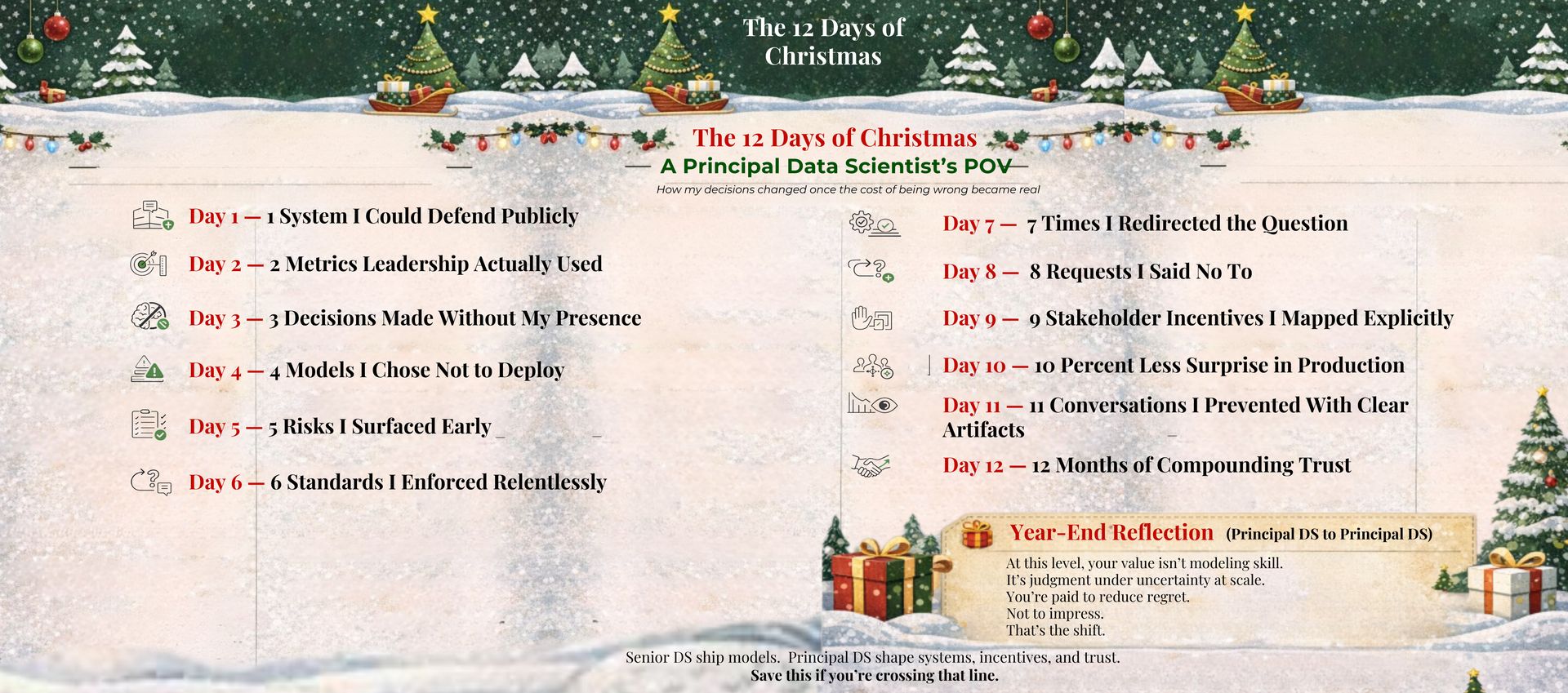
The 12 Days of Christmas — A Principal Data Scientist’s POV
How my decisions changed once the cost of being wrong became real
Day 1 — One System I Could Defend Publicly
Not because it was perfect, but because I could explain its behavior, failure modes, and tradeoffs to executives without hiding behind math.
Day 2 — Two Metrics Leadership Actually Used
They aligned incentives across teams.
No shadow KPIs. No local optimizations.
Just shared direction.
Day 3 — Three Decisions Made Without My Presence
The real milestone wasn’t adoption—it was autonomy.
The organization could act correctly without me in the room.
Day 4 — Four Models I Chose Not to Deploy
Operational cost, data fragility, or governance risk outweighed marginal accuracy.
Restraint scaled better than brilliance.
Day 5 — Five Risks I Surfaced Early
Data quality. Bias. Latency. Drift. Misuse.
Naming risk early saved political capital later.
Day 6 — Six Standards I Enforced Relentlessly
Definitions. Validation. Versioning. Monitoring. Ownership. Sunset criteria.
Principal work is system hygiene.
Day 7 — Seven Times I Redirected the Question
From “Can we build this?”
To “Should we trust this enough to act?”
That reframing changed the roadmap.
Day 8 — Eight Requests I Said No To
Not because they were wrong, but because they diluted focus or increased long-term entropy.
Every yes creates maintenance.
Day 9 — Nine Stakeholder Incentives I Mapped Explicitly
Same model. Different fears. Different rewards.
Alignment mattered more than elegance.
Day 10 — Ten Percent Less Surprise in Production
Early signals. Clear thresholds. Defined rollback paths.
Predictability beats peak performance.
Day 11 — Eleven Conversations I Prevented With Clear Artifacts
Design docs. Assumption logs. Decision memos.
Good documentation is quiet leadership.
Day 12 — Twelve Months of Compounding Trust
Not because I shipped more, but because people knew when not to use what I built.
💡Key Takeaway:
At the principal level, your value isn’t modeling skill... it’s judgment under uncertainty at scale. You’re no longer paid to impress with complexity or novelty, but to reduce regret, prevent downstream damage, and help organizations act with confidence even when conditions aren’t perfect. That shift from builder to steward is subtle, uncomfortable, and unavoidable. And once it happens, you never evaluate your work the same way again.
👉 LIKE if senior data work is more about judgment than technique.
👉 SUBSCRIBE now for real-world reflections on data science at scale.
👉 Follow Glenda Carnate for leadership insights beyond models and metrics.
Instagram: @glendacarnate
LinkedIn: Glenda Carnate on LinkedIn
X (Twitter): @glendacarnate
👉 COMMENT with the moment your role shifted from builder to decision steward.
👉 SHARE with a senior IC navigating trust, risk, and responsibility.
Reply