- Daily Success Snacks
- Posts
- The 12 Data Leadership Mistakes I Stopped Making—and Why Everything Got Easier!
The 12 Data Leadership Mistakes I Stopped Making—and Why Everything Got Easier!
A veteran data leader’s year-end review of decisions that help prevent failure.

Glenda Carnate
December 25, 2025
Read time: 2.5 minutes
This is not a typical 'what I learned this year' list. Instead, it highlights mistakes I have eliminated that previously cost time, trust, and credibility.
Every year-end looks the same on the surface: teams move faster, ship more, and celebrate momentum. But beneath that speed, something else happens. Assumptions remain unwritten, metrics multiply, and automation fills gaps where judgment once lived. Deadlines compress, reviews soften, and decisions get justified after the fact instead of before. What feels like progress often turns into a cleanup a few months later.
Early in a career, this pace feels like proof of value. Later, it becomes a risk. Veteran leaders don’t move faster because they work harder or build more. They move faster because they’ve learned what to stop repeating, what to say no to, and which mistakes quietly erode trust, clarity, and decision quality long before anything breaks.
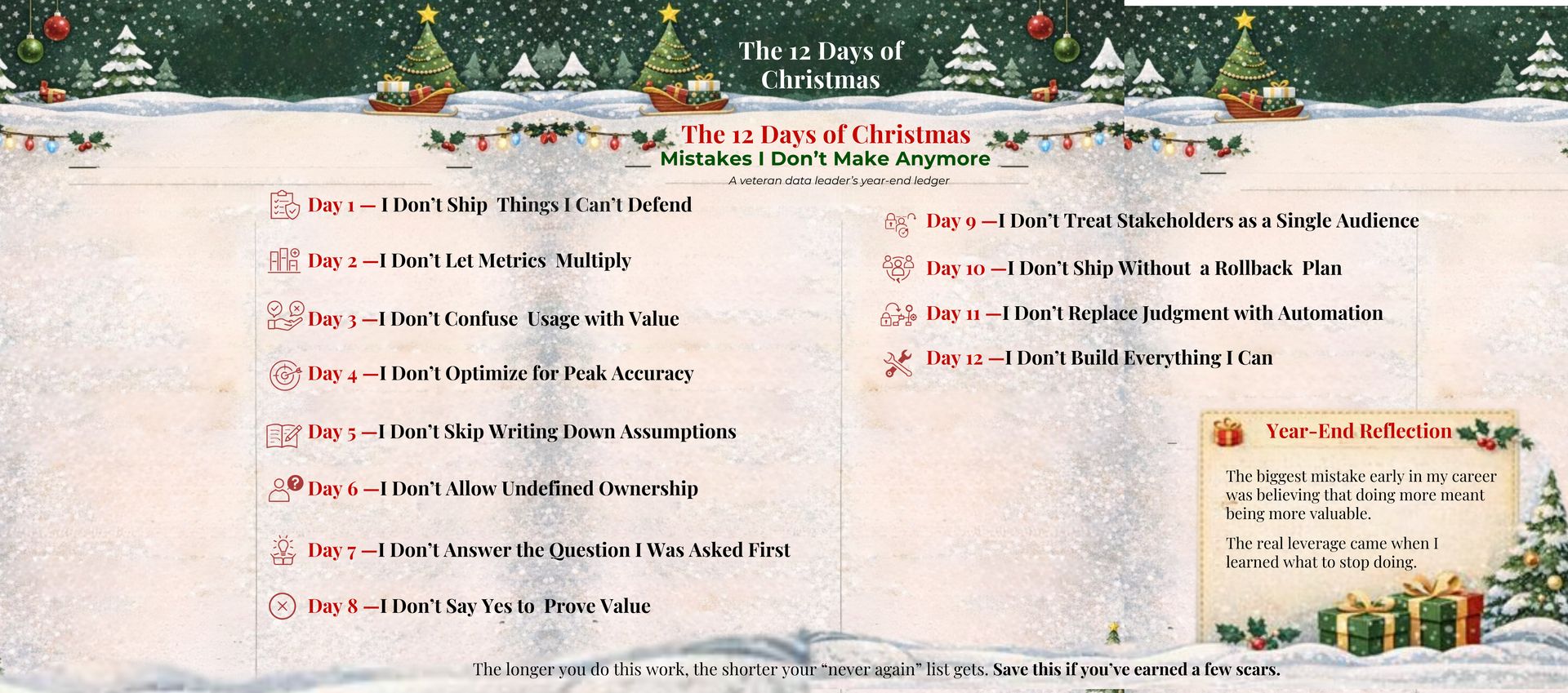
The 12 Data Leadership Mistakes to Avoid
A year-end summary from a veteran data leader
Day 1: I Don’t Ship Things I Can’t Defend
If I cannot explain how it works, how it fails, and who owns it, I do not release it.
Brilliance without accountability is just risk.
Day 2: I Don’t Let Metrics Multiply
Every new metric creates a new argument.
Fewer metrics force clearer thinking.
Day 3: I Don’t Confuse Usage with Value
High usage can mean confusion.
Low usage can mean clarity.
Impact shows up in decisions, not clicks.
Day 4: I Don’t Optimize for Peak Accuracy
The last percent costs the most trust.
Stability, interpretability, and survivability win in production.
Day 5: I Don’t Skip Writing Down Assumptions
Unwritten assumptions fuel post-mortems.
What isn’t written gets rewritten under pressure.
Day 6: I Don’t Allow Undefined Ownership
If no one owns it, it fails quietly at first, then more visibly.
Ownership is a reliability feature.
Day 7: I Don’t Answer the Surface Question First
I answer the one beneath it.
Asking, “What decision is this for?” can save months of effort.
Day 8: I Don’t Say Yes to Prove Value
I say no to protect it.
Restraint builds credibility faster than speed.
Day 9: I Don’t Treat Stakeholders as One Audience
Same data. Different fears. Different incentives.
Overlooking these differences often leads to good work being rejected.
Day 10: I Don’t Ship Without a Rollback Plan
If it can’t be reversed, it isn’t understood.
Reversibility is confidence, not caution.
Day 11: I Don’t Replace Judgment with Automation
Automation amplifies whatever you feed it.
Including bad judgment.
Day 12: I Don’t Build Everything I Can
Experience teaches this last.
Restraint compounds faster than ambition.
💡Key Takeaway:
The biggest mistake early in a career isn’t a lack of skill or ambition. It’s believed that doing more automatically makes you more valuable. Over time, experience makes something else clear: real leverage doesn’t come from speed, volume, or sophistication, but from restraint, judgment, and the discipline to stop doing things that don’t meaningfully change decisions. The leaders who scale trust and impact aren’t the ones who build everything. They’re the ones who know what not to build, and why.
👉 LIKE if fewer mistakes matter more than more output.
👉 SUBSCRIBE now for leadership lessons designed to prevent problems before they escalate.
👉 Follow Glenda Carnate for practical, field-tested insights on data, decision-making, and building trust.
Instagram: @glendacarnate
LinkedIn: Glenda Carnate on LinkedIn
X (Twitter): @glendacarnate
👉 COMMENT with the mistake you have stopped making and your reasons for doing so.
👉 SHARE this with someone who is prioritizing speed when they should focus on judgment.
Reply