- Daily Success Snacks
- Posts
- ‘Just Trust the Model’ — The 4 Words That Quietly Break Data Science in Production
‘Just Trust the Model’ — The 4 Words That Quietly Break Data Science in Production
If your model needs blind trust, it’s already a risk—not an asset.

Glenda Carnate
April 17, 2026
Read time: 2.5 minutes
The harsh reality is that trust is NOT the same as accuracy.
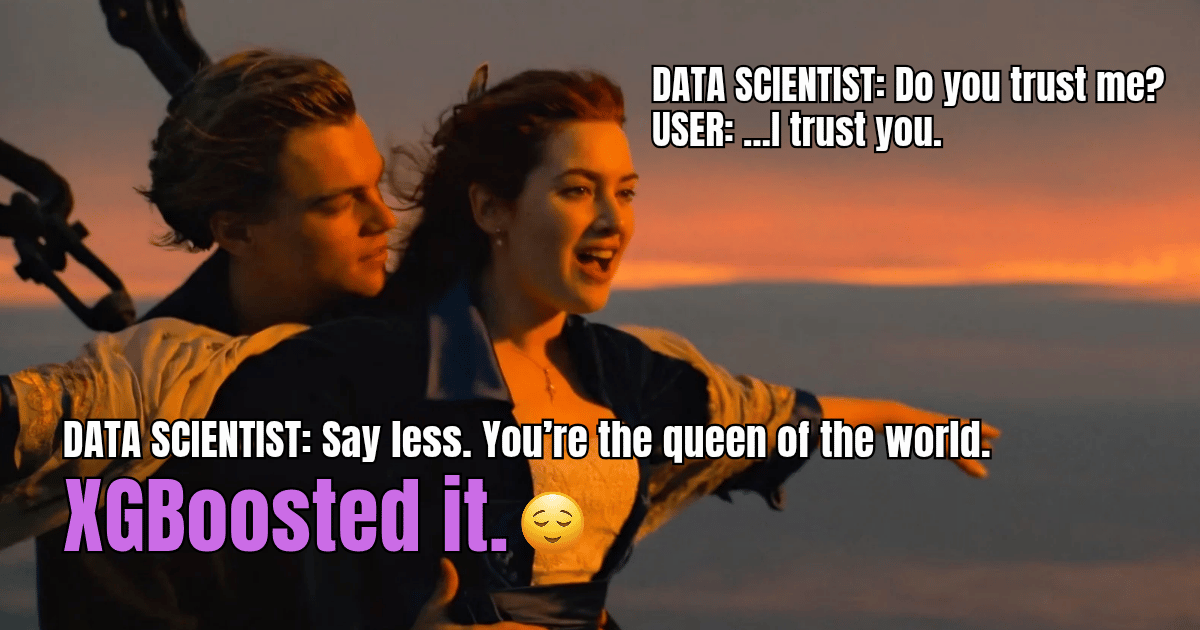
A data scientist develops an XGBoost model, achieving very good metrics. The team is thrilled!
A few weeks later, however, decisions appear to have gone awry, and uncertainty about the model's use is once again raised. It “works,” but as before, there is little, if any, trust to support it. The model was not performing poorly… it just had no trust.
Here are the necessary steps to help your model gain trust:
1. High Accuracy Does Not Equal High Reliability
Offline Metrics fail to replicate real-world variability.
Edge cases can quietly impinge on predicted results.
Fix:
Collect and measure the model's reliability by testing it on specific segments and edge cases.
Continual monitoring of model drift after deployment.
2. A Black Box Model Has Little Adoption
If teams cannot explain the reasons for scoring, they would prefer not to take action.
"It works" will not be sufficient for a decision.
Fix:
Provide feature importance and associated reasoning for every output.
Use an interpretable model layer alongside the black-box model.
3. Models Without Context are a Recipe for Poor Decisions
The model's predictions lack business context.
The model's output does not easily translate into a business decision.
Fix:
Attach a business decision to every prediction made (approve/flag/priority).
Create a business map for every output.
4. Deployment does not equal Integration
The model exists, but the workflow has not changed.
Over time, the teams ignore the model's output.
Fix:
Ensure the model's output is embedded in the tools the teams already use.
Automate whenever possible to minimize friction.
5. Building Trust Before Scale
Early failures with a model will eliminate long-term adoption of that model.
Users will not be provided the same opportunity for a second use.
Fix:
Validate with a small sample before scaling the model to a larger group.
Build confidence in the model's value through consistently strong results.
💡Key Takeaway:
If it requires you to "just trust" it, then it doesn’t qualify as intelligence… it is considered to be a liability.
👉 LIKE if you’ve ever heard “just trust the model”.
👉 SUBSCRIBE now for real-world insights on AI, data science, and decision systems.
👉 Follow Glenda Carnate for frameworks that turn models into impact.
Instagram: @glendacarnate
LinkedIn: Glenda Carnate on LinkedIn
X (Twitter): @glendacarnate
👉 COMMENT “TRUST” if this feels too real.
👉 SHARE this with someone shipping models without adoption.
Reply